


Before a tuning file is modified, the ECU must be identified accurately. A vehicle model, engine size or advertised power output is not enough to select the correct calibration. Vehicles that appear identical can use different engine control units, hardware revisions and software versions.
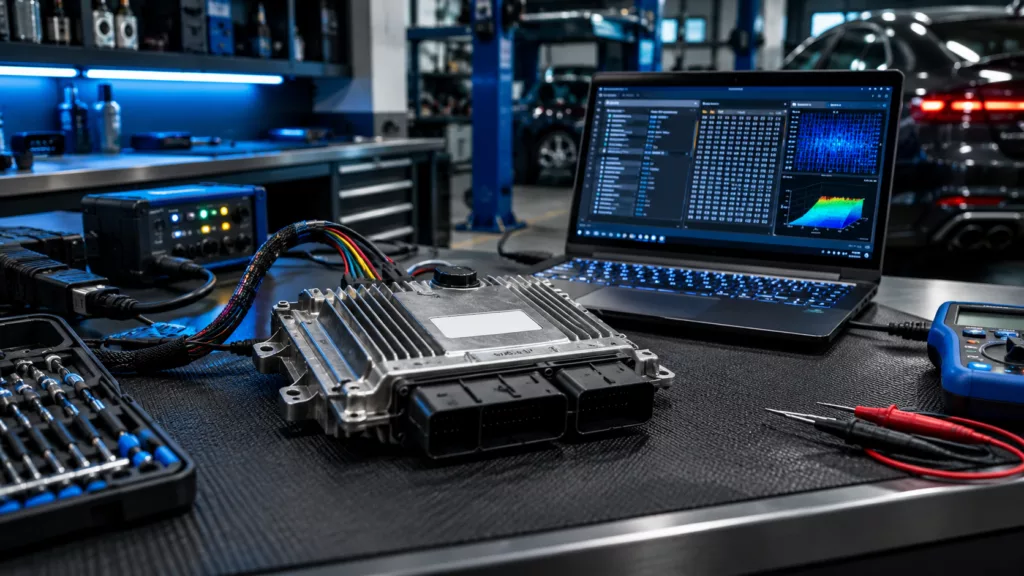
Why ECU identification matters
The ECU controls key engine functions through software calibrated for a particular combination of hardware and vehicle configuration. A file intended for a different software version or hardware variant may be incompatible, may not write correctly, or may produce unexpected behaviour.
Correct identification helps a tuner establish which control unit is fitted, which software is currently installed and whether the supplied readout matches the vehicle being worked on. It is an essential first step before any calibration changes are considered.
What information should be checked?
- Vehicle details: make, model, model year, engine code and factory power rating.
- ECU manufacturer and family: for example, the relevant Bosch EDC, MED, MD or other ECU family.
- Hardware number (HW): the hardware identification shown by the ECU label or diagnostic/programming tool.
- Software number (SW): the software identification read from the control unit or programming tool.
- Calibration identification: software version and calibration identifiers where available.
- Vehicle configuration: gearbox type and any relevant hardware changes that affect the calibration.
- Readout details: the tool and method used to obtain the file, plus whether the read is original or has previously been modified.
HW and SW numbers are not interchangeable
The hardware number identifies the ECU hardware variant, while the software number identifies the software currently associated with that unit. Both matter. Matching only the vehicle model or ECU family can overlook differences between revisions and software applications.
When requesting a tuning file, provide the identification exactly as reported by the tool. Do not replace missing information with a guess or assume that a file from another vehicle with the same engine will be suitable.
Keep the original readout safe
Before making changes, preserve the original readout and record the vehicle and ECU identification alongside it. Keep a separate backup in a secure location. This provides a reference for comparison and can be important if the vehicle needs to be returned to its previous software state.
Also record whether the file has already been modified. An unknown or previously tuned file should not automatically be treated as a factory original. If the file history is unclear, identify and verify it before proceeding.
OBD, bench and boot: record how the file was read
Different ECUs and programming tools support different reading and writing procedures. OBD, bench and boot operations are not interchangeable methods for every control unit. The correct procedure depends on the ECU, tool support and the specific operation being performed.
For that reason, include the tool name and reading method when sending a file for remote calibration. Follow the tool manufacturer’s instructions and use a stable, appropriate power supply during programming.
What to send with a tuning file request
A complete request should include the vehicle make and model, year, engine code, ECU type, HW and SW numbers, gearbox information, relevant hardware modifications, the readout file and the requested work. Clear information reduces avoidable delays and helps the calibration process start from the correct technical reference.
At AN Performance, our work covers chip tuning and ECU solutions, automotive electronics and diagnostics, and a file service for tuners. The right solution always starts with identifying the ECU and understanding the vehicle in front of us.
Final checklist
- Confirm the vehicle and engine details.
- Identify the ECU manufacturer, family and hardware number.
- Record the software and calibration identifiers.
- Confirm the readout method and whether the file is original.
- Save a secure copy of the original readout.
- Document gearbox and hardware changes before calibration.
Accurate identification does not replace proper diagnostics or calibration validation. It makes them possible to approach in a structured and responsible way.